How to Read a Supplement Label, Using the Metatrim BHB Panel as a Guide

Updated September 2026 · reviewed by the Metatrim BHB Research Team. We are an independent information resource, not a medical provider, and this article is educational rather than medical advice. We map the whole category in our guide to the over-the-counter weight-loss pill aisle.
A Supplement Facts panel is the standardized box the government requires on every dietary supplement, listing the serving size, each active ingredient and its amount, and the inactive fillers — and learning to read it is the single best way to compare products honestly. This Metatrim BHB guide walks the panel line by line, using a short, clean keto label as the worked example.
How to read a supplement label in under a minute.
- Start at the top
- Read the serving size and servings per container first — they tell you how many capsules count as one dose and how long a bottle lasts.
- Read the amounts
- Every active ingredient should show an amount per serving in milligrams; a “proprietary blend” hides the individual doses behind one combined total.
- Scan “other ingredients”
- This is the filler line below the panel — capsule, flow agents and colorings; a shorter, recognizable list is usually cleaner.
- Sanity-check the claims
- A Supplement Facts panel describes nutrients, not cures — any promise to diagnose, treat or cure a disease is a red flag.
Two bottles can make near-identical promises on the front and be completely different products on the back. The front is marketing; the Supplement Facts panel on the back is where the real information lives. Once you can read that panel, you stop buying claims and start buying doses. Below we walk the label top to bottom, then hold it up against the clean, short panel on Metatrim BHB. A systematic review of dietary supplements marketed for weight loss concluded that the evidence behind most of them is weak or of low quality (Batsis et al., “A Systematic Review of Dietary Supplements and Alternative Therapies for Weight Loss,” Obesity, 2021).

What is a Supplement Facts panel?
The Supplement Facts panel is the black-and-white box the U.S. Food and Drug Administration requires on every dietary supplement, and it follows a fixed order so any two products can be compared side by side. It carries the same elements in the same sequence: the serving size at the top, then each ingredient with its amount per serving, an optional percent Daily Value column, and finally — just below the box — the “Other ingredients” line. The format is standardized, so a label is less an advertisement than a spec sheet; the trick is knowing what each row is telling you. The checks worth running before you buy are collected in our guide to choosing a BHB supplement.
Keep one idea in mind: a supplement label describes what is in the bottle, not what it will do. The panel can tell you exactly how many milligrams you are getting; it cannot promise a result, and by law it should not claim to treat disease.
| Panel row | What it means | Why it matters to a shopper |
|---|---|---|
| Serving size | How many capsules, scoops or tablets equal one dose | All the amounts below are per serving, not per capsule — misread this and every number is off. |
| Servings per container | How many doses the bottle holds | Turns a sticker price into a true cost per serving for fair comparison. |
| Amount per serving | Milligrams (or grams, IU, mcg) of each ingredient | The actual dose — the number research talks about. |
| % Daily Value | Share of a reference daily intake, where one exists | Useful for vitamins and minerals; often blank for novel ingredients. |
| Proprietary blend | Several ingredients under one combined weight | You see the total but not each individual dose. |
| Other ingredients | Inactive fillers, capsule material, flow agents | Shorter and more recognizable is generally cleaner. |
What does the serving size actually tell you?
The serving size is the number of capsules, tablets or scoops the manufacturer counts as a single dose, and every amount printed below it refers to that serving, not to one capsule. This is the row people misread most. A label might advertise “800 mg” on the front, but if the serving size is two capsules, a single capsule carries only 400 mg — take one a day and you get half of what you assumed.
Pair the serving size with servings per container and the price, and you get the only honest comparison metric: cost per serving. A cheaper bottle with 20 servings can cost more per dose than a pricier one with 60. For a worked example, see our guide to how much BHB per day and the 800 mg dose.
What is a proprietary blend, and should you worry about it?
A proprietary blend is a group of ingredients listed under a single combined weight, so you see the total milligrams but not how much of each individual ingredient the product contains. Makers use blends to protect a formula and, sometimes, to obscure how little of an expensive ingredient is actually present — a practice called “fairy dusting.”
A blend is not automatically a problem. Rules require the ingredients to be listed in descending order by weight, so the first-named is the most abundant; what you lose is the exact split. Judge a blend on three things: the total amount, whether the named ingredients are ones you want, and whether that total matches amounts described in independent research such as Examine.com. A 50 mg blend of ten exotic extracts is far more suspect than an 800 mg blend of three named minerals.
See the exact dose in Metatrim BHB →
How do you read the “other ingredients” line?
The “Other ingredients” line is the fine print just below the Supplement Facts box that lists everything inactive — capsule material, flow agents, fillers, binders and colorings — that is not a labeled nutrient. It is easy to skip, but it is where a lot of a product's character is decided.
What counts as a filler?
Common inactive ingredients include gelatin or vegetable cellulose (the capsule itself), rice flour, magnesium stearate (a flow agent), silica and colorings. Most are harmless in the tiny amounts used. The signal is length and familiarity: a two- or three-item line of things you can name is generally cleaner than a paragraph of additives and dyes.
Does a short list guarantee quality?
No — a short filler list is a good sign, not a certificate. It tells you the maker did not pad the capsule, but it does not verify potency or purity. For that you look for third-party testing and manufacturing standards, which brings us to comparing labels properly.
What do “% Daily Value” and “amount per serving” mean?
The percent Daily Value is the share of a government reference intake that one serving provides, shown only for nutrients that have an established reference. For a vitamin or mineral, a %DV of 50% means one serving supplies half of the general daily target. For newer ingredients — many herbal extracts, and BHB salts among them — no official Daily Value exists, so that column is left blank or marked with a dagger. A blank %DV is normal, not a defect.
The number that always matters is the amount per serving. That milligram figure is the one you carry into the research literature, such as the PubMed index, to ask whether the dose in the bottle matches the dose that was actually studied.
How do you compare two supplement labels fairly?
Fair comparison means normalizing everything to one serving, then reading the same rows on both bottles in the same order: serving size against serving size, total active amount against total active amount, filler list against filler list, price per serving against price per serving. Front-of-bottle adjectives — “advanced,” “clinical,” “maximum” — carry no legal definition and should be ignored. The table below turns that into a quick green-flag / red-flag scan.
| On the label | Green flag | Red flag |
|---|---|---|
| Active amount | Named ingredients with clear per-serving milligrams | Huge blend total with no individual amounts, or a tiny total |
| Proprietary blend | Few, recognizable ingredients in descending order | Long list of exotic extracts under one small weight |
| Other ingredients | Two or three familiar items | Paragraph of additives, dyes and unpronounceable fillers |
| Claims | Structure/function wording plus an FDA disclaimer | “Cures,” “treats,” “melts fat,” before-and-after promises |
| Maker | Address, contact, made in a GMP facility | No company details, no way to get in touch |
What does a clean label look like? The Metatrim BHB example
A clean label is one where every active ingredient is named, the amounts are easy to find, and the “other ingredients” line is short enough to read in a breath — and that is what the Metatrim BHB panel is built to be. Its Supplement Facts box lists an 800 mg proprietary blend of magnesium, calcium and sodium beta-hydroxybutyrate in a two-capsule serving, at 30 servings per bottle. The blend is proprietary, but it is three named minerals in descending order, not a mystery stack, and the total is in line with everyday BHB-salt products. If you want the chemistry behind those three salts, our explainer on what BHB is and how exogenous ketones work covers it in plain language. In humans, a measured dose of exogenous ketones lifts blood beta-hydroxybutyrate for a matter of hours before the body clears it again (Stubbs et al., “On the Metabolism of Exogenous Ketones in Humans,” Frontiers in Physiology, 2017).
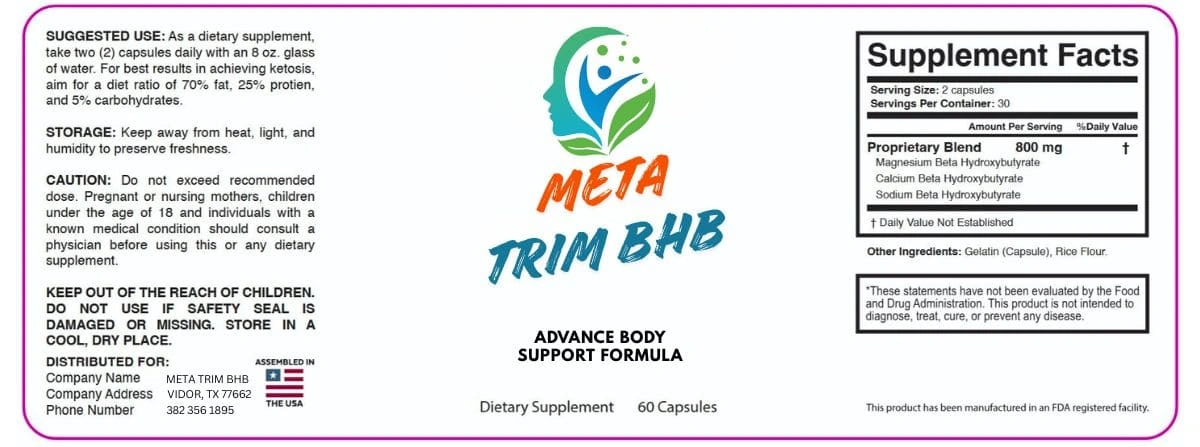
The “other ingredients” line is the tell. On Metatrim BHB it is just the gelatin capsule and a little rice flour — no dyes, no long additive paragraph. That is not proof the product will change your life; no honest label can promise that. It is proof that what you are paying for is BHB and its mineral partners, with almost nothing else along for the ride.
Read the panel, then decide
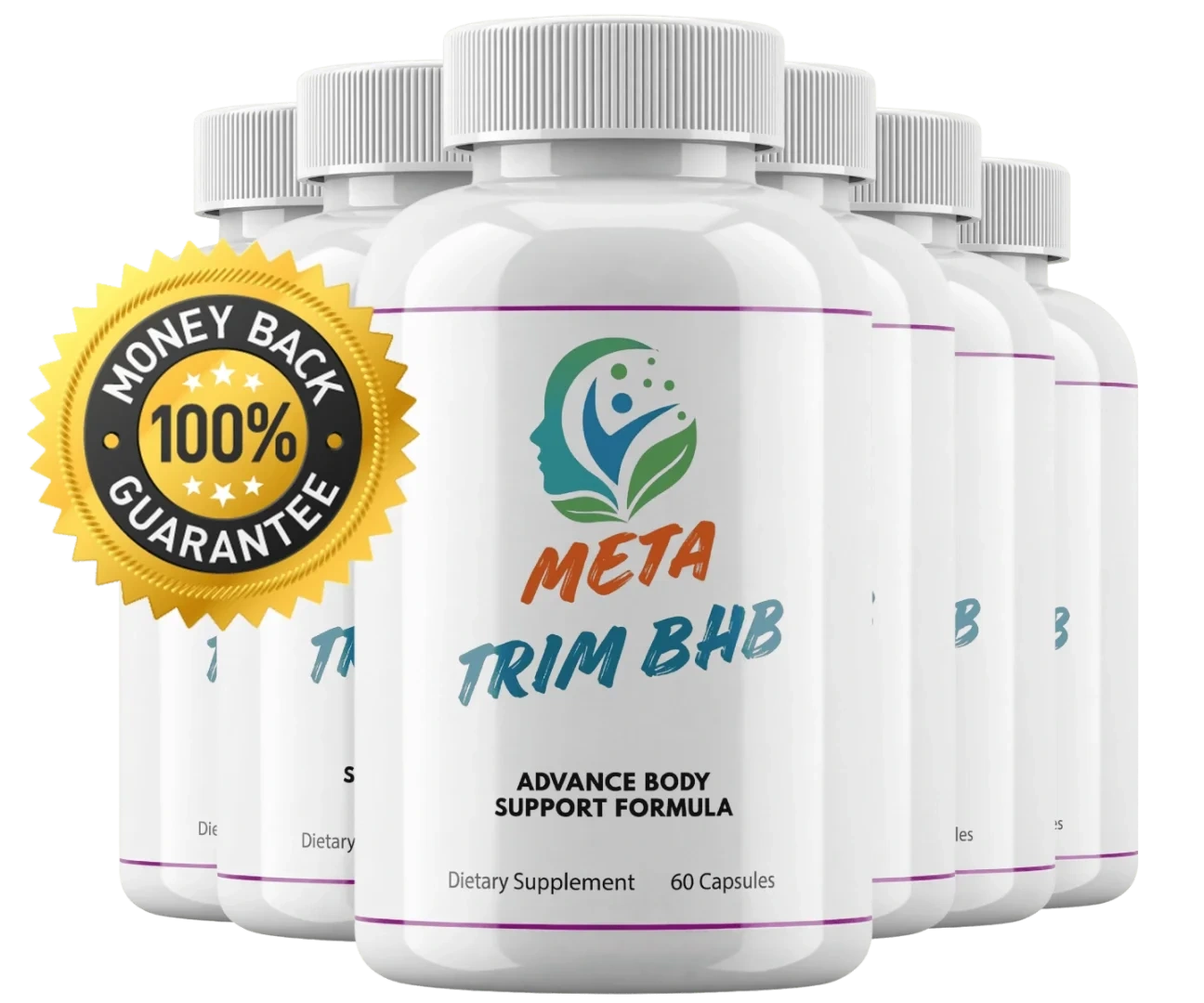
Metatrim BHB puts an 800 mg blend of three named BHB salts and a two-item filler line on its label — nothing to squint at. The six-bottle bundle is the best value at $49 per bottle, with free U.S. shipping and a 60-day guarantee.
Check today's Metatrim BHB pricing — from $49/bottleWhat are the red flags to watch for?
The clearest red flag on any supplement label is a claim to diagnose, treat, cure or prevent a disease, because that language is not allowed on a dietary supplement and signals a maker willing to cross a line. A legitimate label uses cautious “structure/function” wording — supports, helps maintain — and carries the FDA disclaimer. Beyond claims, watch for a very long filler list, a blend total with no named ingredients, missing contact details, and pricing that only makes sense once you ignore the cost per serving. None of this requires a chemistry degree: turn the bottle over, read the panel top to bottom, normalize to one serving, and let the label — not the front-of-pack adjectives — decide. The gap between how supplements are actually regulated and how buyers assume they are regulated has been documented in the public-health literature (Starr, “Too little, too late: ineffective regulation of dietary supplements in the United States,” American Journal of Public Health, 2015).
Frequently asked questions
Where do I start when reading a supplement label?
Start at the top of the Supplement Facts panel with the serving size and servings per container. These tell you how many capsules count as one dose and how many doses the bottle holds, which is the only fair basis for comparing two products or their price per serving.
What is a proprietary blend on a supplement label?
A proprietary blend is a group of ingredients listed under a single combined weight, so you see the total milligrams but not the individual dose of each ingredient. It is legal and common, but it makes it harder to know whether an active ingredient is present at a meaningful amount.
What does the “other ingredients” line mean?
The Other ingredients line lists everything inactive that is not a labeled nutrient, such as the capsule material, flow agents, fillers and colorings. A short, recognizable list generally signals a cleaner product than a long one full of unfamiliar additives.
Is a proprietary blend always a bad sign?
No. A proprietary blend is not automatically bad, but it does reduce transparency. Judge it by the total amount, whether the individual ingredients are named in descending order, and whether that total is in line with amounts described in independent research.
How much BHB does the Metatrim BHB label list?
The Metatrim BHB Supplement Facts panel lists an 800 mg proprietary blend of magnesium, calcium and sodium beta-hydroxybutyrate per 2-capsule serving, with 30 servings per bottle. Its only other ingredients are the capsule and a little rice flour.
What are the biggest red flags on a supplement label?
The biggest red flags are treatment or cure claims, a very long filler list, no way to contact the maker, and huge blend totals with no named ingredients. A Supplement Facts panel describes nutrients, so any promise to diagnose, treat or cure a disease is a warning sign.
Check today's Metatrim BHB pricing →
Metatrim BHB is a dietary supplement, not a treatment for any medical condition. These statements have not been evaluated by the Food and Drug Administration. This product is not intended to diagnose, treat, cure or prevent any disease. Always consult a qualified healthcare professional about your individual needs.
References & further reading
- National Institutes of Health, Office of Dietary Supplements. Dietary Supplements: What You Need to Know. ods.od.nih.gov/factsheets/WYNTK-Consumer
- National Institutes of Health, Office of Dietary Supplements. Magnesium — Fact Sheet for Health Professionals. ods.od.nih.gov/factsheets/Magnesium-HealthProfessional
- Examine.com. Ketone Bodies — evidence-based summary. examine.com/supplements/ketone-bodies
- Mayo Clinic. Dietary supplements: What to know before you buy. mayoclinic.org/…/supplements/art-20044894
- National Center for Complementary and Integrative Health (NCCIH). Using Dietary Supplements Wisely. nccih.nih.gov/health/using-dietary-supplements-wisely
These references describe supplement labeling and nutrition in general terms and do not constitute evidence that any product treats, cures or prevents any condition.
Keep reading: what BHB is and how exogenous ketones work · how much BHB per day · back to the Metatrim BHB blog · homepage.